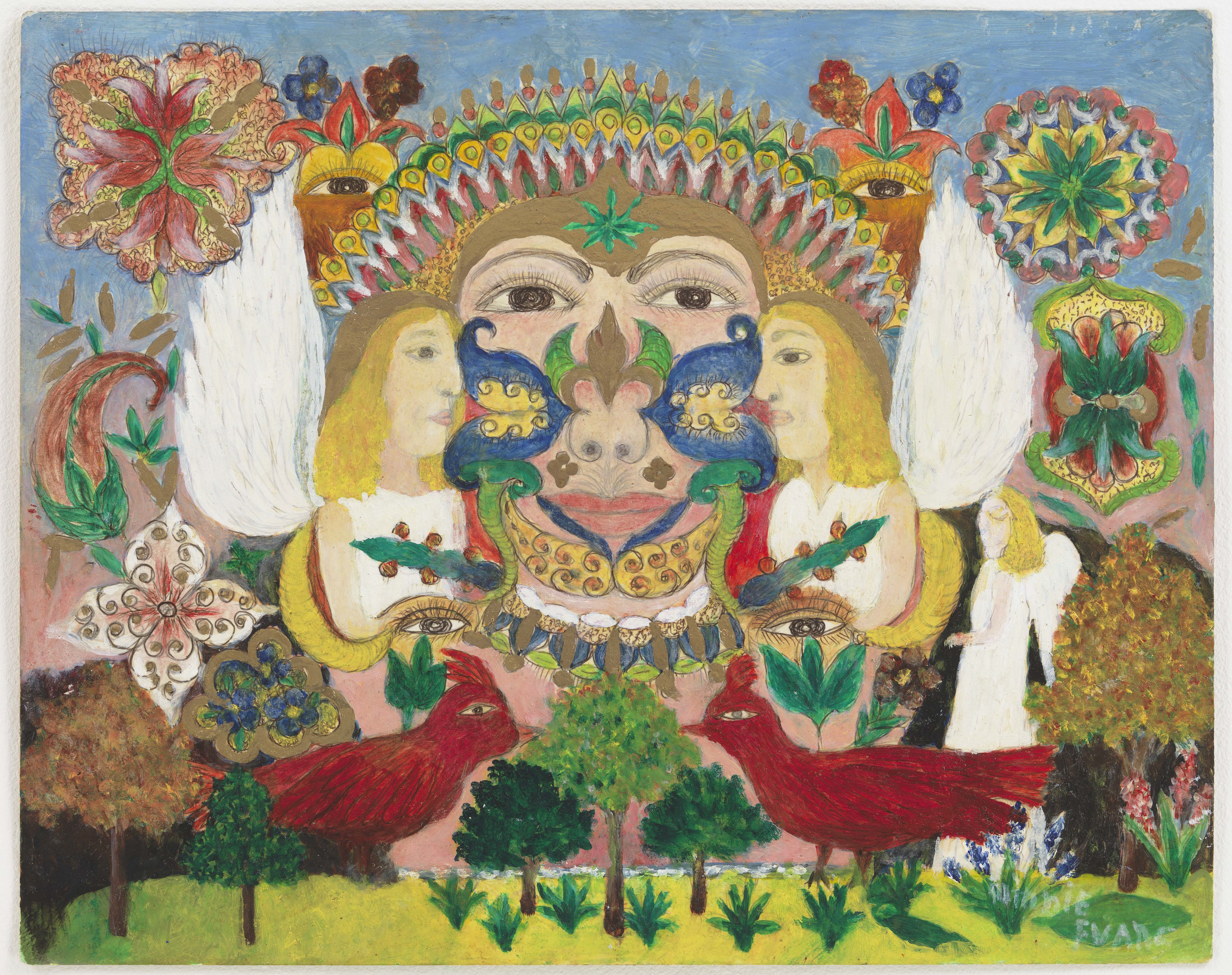
Evans hung her drawings for sale on the gate at Airlie Gardens, where she worked as gatekeeper, and let visitors decide what they were worth. She made the first one on Good Friday in 1935, in her early forties, after her grandmother died and the visions she had carried since childhood got louder. The Whitney gave her a one-person show in 1975, among the first it gave any Black artist. Then almost nothing for three decades. The Lost World puts more than a hundred drawings, paintings and collages from 1935 to 1981 on Floor 8, organized by the High Museum in Atlanta under Katherine Jentleson, with Barbara Haskell handling the Whitney installation. The hang is chronological, which is the right call: the spare pencil lines of the 1930s tighten into the mandala compositions of the 1960s, and you watch a private vocabulary harden into a system. Christian imagery, Caribbean ancestry, the Jim Crow South and the specific plants of one Wilmington garden, all held in bilateral symmetry. The gap is that a museum can only return to a name it already held; the work itself never went anywhere. Through January 10, 2027.
8.7SCORECROWNFINDHEAT 26▮
FIND — the score is ahead of the room.
BENCHMARK IN THE 50 · Lauren Halsey — nearest on the 50 for a dense symbolic surface built out of one specific Black place, and the distance is worth naming: Halsey builds monuments for a neighborhood that is still standing, Evans drew a world she said was destroyed before the Flood
 THE MUSA FAMILY · HEIRWAVE
← THE INDEX
THE MUSA FAMILY · HEIRWAVE
← THE INDEX